

Cold turkey
Eating meat again after 10 years of vegetarianism

When I was 19, I stopped eating meat. Cold turkey, if you will.
It was 2016, summer. I had a few jobs — working at some music venues in town and at a restaurant on my college campus — so I was driving around a lot. I was living at home, splitting time between my parents’ houses, which meant I never really had one place to land. No one kitchen to cook in, one closet to get dressed from, one bedroom to come home to. My things were split between two houses — three, sometimes, because I spent a lot of time at my sister’s — so I moved through my own life with a few duffel bags full of clothes and makeup at a time. I didn’t cook a lot, and I mostly just ate whatever was around. Or, the more likely option, I got takeout or fast food. I was unsettled in every part of my life and could not land on a healthy diet in any way.
I had explored vegetarianism before, usually in little stints of a few months at a time. My first year of college, adjusting to the “you can eat whatever you want” dining hall lifestyle, I’d sometimes go weeks without eating meat and barely notice.
But the summer before my junior year was not that. That summer brought me to Buffalo Wild Wings more often than any one 19-year-old girl should ever be at a Buffalo Wild Wings.
A few weeks before classes started, I got the keys to my apartment for the next year. I visited it and brought my everyday lunch to eat on the carpet before heading to my campus restaurant job after. Sitting there, eating the same spicy garlic wings and fries I’d eaten nearly every day, I felt what can only be described as a primal urge to stop. I suddenly felt averse to the food in front of me. My body was sending me a very clear message, or at least it felt that way. I put the fork down, threw the rest of it in the trash and decided I was done eating meat.
I quit cold turkey. Told my friends and family I was done eating meat and that was that. Though the actual reasons weren’t entirely clear to me at the time, I told everyone whatever option I felt like sharing whenever someone asked me — I’m doing it for my health, for the animals, because it feels like what my body needs right now, so I’ll stop eating Buffalo Wild Wings five times a week. Whatever I could conjure up at the time of asking. Internally, though, it was harder to explain. It felt instinctual more than anything.
For the first few years, I felt relief in that choice, not restriction. Once I got over the hump of reframing my meal options, it became second nature to look at a menu and immediately know I could probably eat 5% of the dishes, if that. I usually settled on a side Caesar and fries or something else boring and meatless. But I got used to it. I was freshly 20, at a time when I didn’t feel especially in control of my life or my body or my future. I wanted to feel like I could at least control this one thing. I didn’t have to think about whether I wanted the chicken or the burger or the wings. I didn’t eat meat. That was it.
It also became one of those boring facts about me that people remembered. Not in a bad way, just: Carly doesn’t eat meat. Carly can have the fries. Carly probably can’t eat that. Carly, we made sure there’s a veggie option! Everyone in my life was so accommodating and, generally, thought about me being a vegetarian more than I ever personally thought about it. For a while, it was mostly fine. Sometimes annoying, but fine. I didn’t really miss meat. I didn’t crave it. I didn’t sit around thinking about burgers. I became very good at not wanting what wasn’t available to me.
Then, slowly, and in a way I didn’t notice until several years later, my OCD took over.
I was debilitatingly afraid of becoming sick — mainly of throwing up — and OCD latched onto not eating meat as a compulsion that I could use to avoid that. No fewer than a hundred times in the last decade I have said I would never eat meat again, and while the reason I gave people was usually that I “just didn’t want to,” the actual answer was that I could not imagine a future where I got past the roadblock OCD had placed in front of me.
At some point, the whole thing got murky. I still said I was vegetarian because I didn’t want meat, because that was technically true enough. But underneath that, OCD had built a whole security system around the decision. I reasoned with myself: if I don’t eat meat, I am statistically much less likely to get food poisoning. What are those statistics, you might be asking? I have no idea. I made them up. I saw the “CONSUMING RAW OR UNDERCOOKED MEATS, POULTRY, SEAFOOD, SHELLFISH, OR EGGS MAY INCREASE YOUR RISK OF FOODBORNE ILLNESS” warning at the bottom of every restaurant menu and my OCD ran with it, fueling the fire for at least half a decade.
The annoying thing about this particular compulsion is that it looked completely normal. Admirable, even. Nobody hears “I’m a vegetarian” and thinks, “Wow, sounds like your brain is holding you hostage!” They think you have values and willpower. They think you are probably eating a lot of lentils or beans. I was not, in fact, eating many lentils and virtually no beans. “I’m a vegetarian” became a shortcut. It was significantly easier than saying, “I am terrified of throwing up and I’ve decided this entire category of food is a liability.” Easier than admitting that a choice I once made freely had become a rule I physically could not break.
Through all of this, I thought I was listening to my body. I had no idea I was feeding the OCD in the name of “intuitive eating.” I was tired and vitamin deficient. I was building meals out of whatever vegetarian option happened to be available, which often meant cheese, bread, fries, a sad salad or some combination of the above. Caesar salad and fries, usually. And beyond the actual nutrition of it all, I was depriving myself of the joy of a shared meal. Which, frankly, sounds dramatic, until you think about how much of life happens over a shared meal.
It’s not even just the big meals, either. Weddings, holidays, birthdays, trips, dinner at a friend’s house, splitting appetizers, trying the place someone loves, ordering whatever looks good without doing a full risk assessment first. Food is how people take care of each other. Food is how people show you where they’re from. Food is how people say, “You have to try this.” For a long time, I had a built-in reason not to and nobody ever asked me to explain myself.
And then, about a month ago, I woke up with that same strange, primal feeling I had on the carpet with my Buffalo Wild Wings 10 years ago, except this time it was pointing me in the opposite direction.
I was hungry in a biological and spiritual way, in a way I had not ever felt before. I sat with the feeling. I’ve been in ERP therapy for nearly six months and most days, my OCD is more manageable than it ever has been, which is a real testament to the painful and exhausting work I’ve been doing for myself. For the first time in a decade, I wanted to eat meat, and I wasn’t going to stop myself.
I approached it carefully. I started talking about it before actually doing it — speaking it into existence, testing the waters. Friends offered to cook meals for me, volunteered to take me to our favorite restaurants so I could try new dishes for the first time. I felt a lot of support and, generally, very little fear. So I made a plan: I’d start with fish to ease my body and my spirit back into it. A friend would cook salmon and I would try a little piece. A slow entry. Just barely sticking my toe into the water.
So I did it. And I wish I could say the first bite felt cinematic in any way but it mostly just felt like eating a bite of salmon. And then I waited for the fear to come. I analyzed my thoughts, I checked my body signals. I felt nothing — other than real satiation, maybe for the first real time in a decade — and it was perfect. I kept going slowly after that. Taking bites of fish here and there, slowly working my way up to a full meal. I wanted to make sure I could physically and emotionally handle it. And I could.
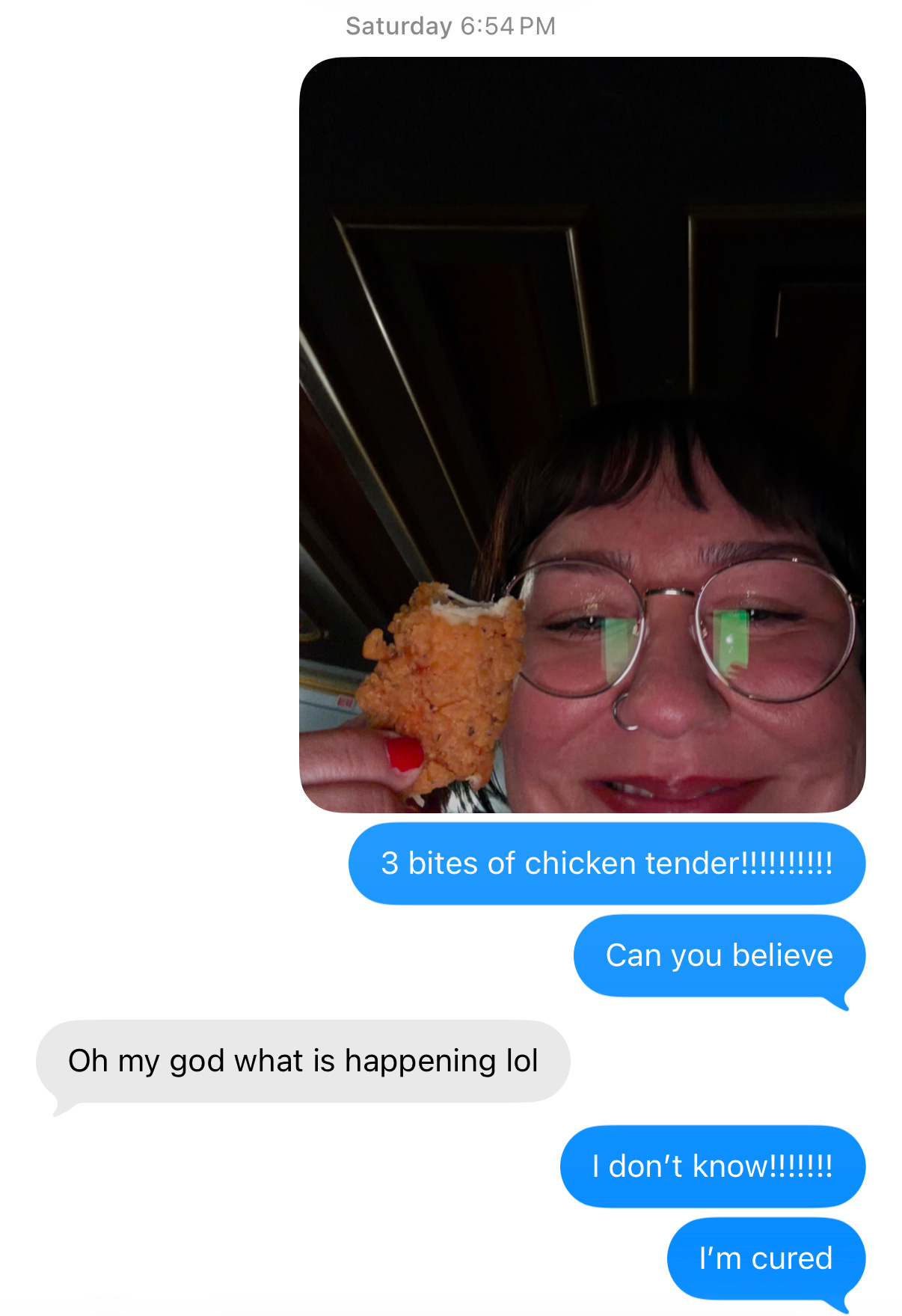
I’m still not eating meat for every meal or planning on going to a steakhouse any time soon, but I’m not closing myself off to anything. I’ll take a bite when it’s around. Last night, I took a bite of a piece of pizza with sausage on it and felt absolutely nothing, except that it tasted good. Really, I am just trying to make food less symbolic. I am trying to let eating be eating, trying to choose nourishment over fear. Emphasis on all of the “trying.”
There is no way to know if this feeling of comfort and ease around food will last. A rogue piece of food might trigger me. I might get sick. Something else might happen. But I’m leaning on the ERP therapy heavily right now because while something “bad” could happen as a result of eating meat, I have no control over it and that is fine.
What I am dealing with, though, is the residual grief. Grief feels like a dramatic word for this, but I can’t find a better one. Grief for the last 10 years of my life, having deprived myself, intentionally and dramatically, and made my life smaller in the name of discipline. I know that sounds harsh. I don’t want to be cruel to the version of me who needed the rule because, I’ve realized, she was just trying to feel safe in a brain that absolutely could not handle uncertainty. She was trying to make life manageable.
But I am sad for her. I am sad for every time she ordered the one thing on the menu she could eat and pretended it was fine. I am sad for every dinner that became more logistical than nutritional. I am sad for every bite she didn’t take because fear had already removed the option from the table in front of her.
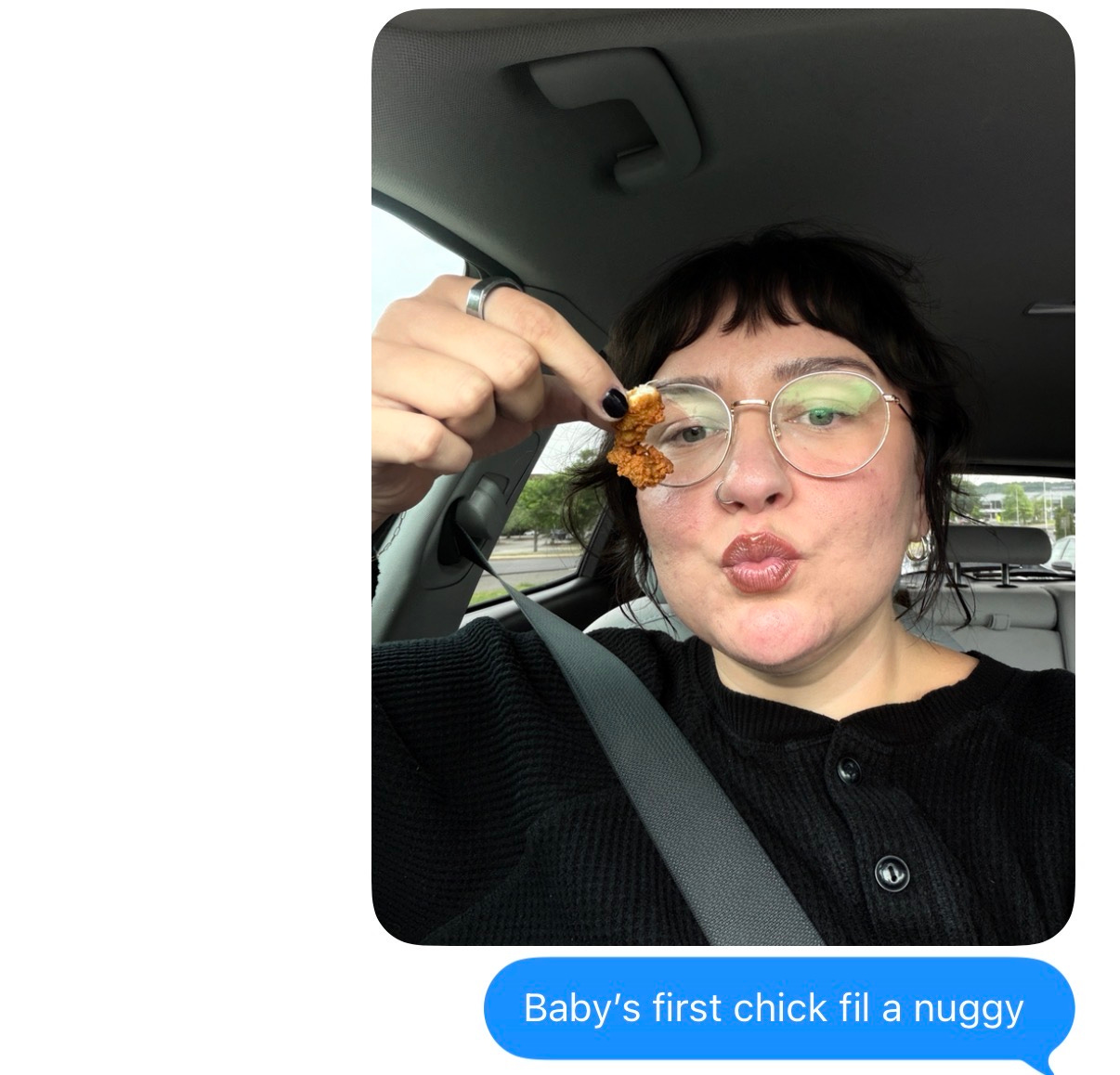
I also feel a little embarrassed, which is maybe the harder thing to admit. I made such a big deal about something and then changed my mind. Embarrassed that people might think I was lying before or giving up now. Embarrassed that I spent years saying I would never eat meat again and now here I am, eating a chicken tender and living to tell the tale. But what I am having to repeatedly tell myself is that changing your mind doesn’t mean the original choice was fake or invalid. It means something changed. In this case, a lot changed. My body changed. My brain changed. My understanding of my OCD and my brain has drastically changed. My tolerance for living inside a shrinking list of acceptable foods changed.
I don’t think eating meat again has made me more evolved or less annoying or finally normal, despite repeatedly texting my friends that I’m “cured” and that I’m “normal again.” I don’t want to swing from one rigid identity into another one. I mostly just want to eat dinner without it being anything. I just want food, a body that is allowed to want what it wants, and a brain that can be scared without immediately taking over.
i literally went through the same thing!! i was vegetarian for 10 years because of my fear of throwing up. trying meat again was my biggest mental win<3
I relate! Also became a vegetarian young based partly on my OCD and fear of vomit.